East Asia Journal | Xinjiang | June 2025
China's Uyghur Police State

Xinjiang, the largest province in China located in the far west of the country bordering Kazakhstan, Russia, Kyrgyzstan, Tajikistan, Afghanistan and Pakistan, is a crossroad of culture with 47 recognised ethnic groups living within the region. The most populous ethnicity within Xinjiang are the Uyghurs, a predominantly Muslim Turkic people group, with about 11.6 million or 44% of the province’s population. Their history in the region can be traced back over 5000 years, with many Uyghurs claiming they are the original inhabitants of Xinjiang. The Uyghur language has varying degrees of mutual intelligibility with other Turkic languages in the Central Asian region, particularly Uzbek.
In recent years, especially from 2014 onwards, the Uyghurs have faced severe persecution by the Chinese Government in a crackdown within the Xinjiang province. After violent riots in Urumqi in 2009 between Han and Uyghur residents, and a series of terrorist attacks that followed, the official reasoning from the Chinese government is of public safety, anti-terrorism and anti-separatism. The crackdown saw human rights abuses on a mass scale, with detention (or ‘re-education’) camps being used to detain as many as 1.5 million Uyghur men, women and children. There are also reports and evidence of torture, mass sterilisation and forced labour among the Uyghur population. As of 2025 the Chinese Government insists the camps were schools for Uyghurs to learn new skills, Chinese language and culture, and denies any abuse of human rights.
This photo journal focuses on the increased surveillance and presence of the Chinese Government in the province, and the attack on Uyghur culture, travelling from west to east throughout Xinjiang.


Id Kar Mosque, Kashgar. An important Islamic site of the city, now a heavily visited tourist attraction. China has been destroying or repurposing mosques in an attempt to remove Islamic influences from the region, some such as Id Kar being turned into a place for tourists with souvenir shops inside. Outside, the city fire brigade shoot a promotional video. On the top of many mosques the Chinese flag can be seen flying

Around Xinjiang, police vans can be spotted with safety notices or communist party slogans along them. They are positioned along most major roads in Kashgar with armed police sometimes present.

Starting in the early 2000s, the Chinese Government started the process of ‘urban renewal’ within Kashgar. This ongoing project has seen much of the ancient mud-built Uyghur old town demolished and rebuilt in a similar but almost comical style. The old town now acts as almost a Disneyland style attraction popular with tourists from all over China, with few Uyghur residents still living within its boundaries. Across Xinjiang, ancient and important Uyghur sites have been turned into flashy attractions for domestic tourists, belittling Uyghur culture in many places. Although walking through the old town is like a theme park, the presence of often armed police is still apparent.
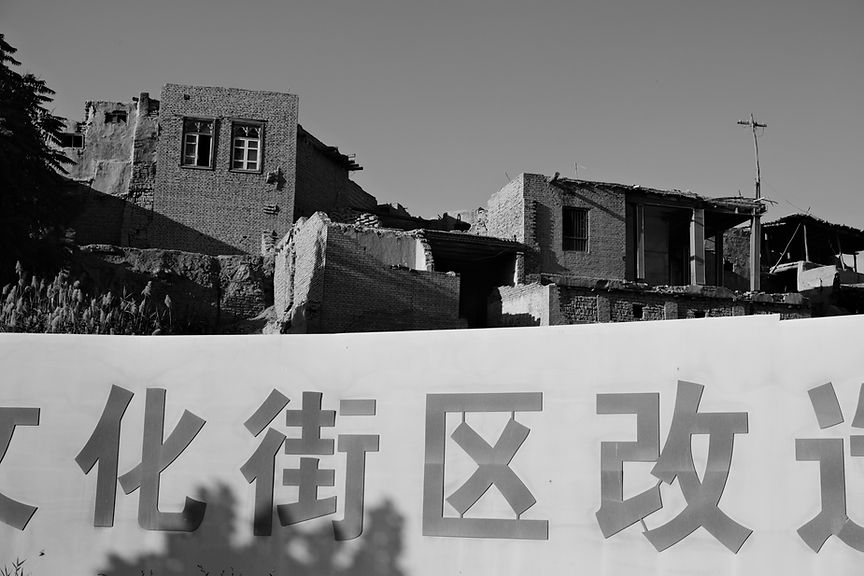
On the edge of the ‘old city’ a sectioned off mud brick neighbourhood still stands awaiting demolition. Most of the residents would have been evicted, some by force, and resettled in apartments in high-rise towers somewhere else in the city. The walls of this neighbourhood put up by construction workers talk about the ‘preserving city culture’ and public safety.

The dilapidated roof tops of the old neighbourhood, with the new high-rise buildings of Kashgar in the background.

A semi demolished mud brick house. Likely a few hundred years old built by a Uyghur family.

A large statue of Chairman Mao stands waving over the entrance to People’s Park. The statue perfectly embodies the Chinese Government’s attempts to ‘Chinesify’ Xinjiang in this remote city over 2000 miles away from Beijing. The red banner beneath the statue reads ‘Build a beautiful Xinjiang and fulfil the dream of the motherland together’.

The watchful eye of the government reaches even remote villages in the Xinjiang region. In this small Uyghur farming village in the Kashgar region, surveillance can be spotted in every street. The Uyghur people that inhabit these villages are timid and fearful of a camera.

All throughout the countryside, abandoned and semi demolished Uyghur villages can be spotted. This is likely part of the efforts of the Chinese Government to break Uyghur culture and to assimilate the people into large cities with the Han Chinese. Many new factories and jobs have been established in urban centres across Xinjiang to pull Uyghurs away from a traditional way of life.

Kuqa. Police man each main road through the city, the police presence in Xinjiang is far greater than the rest of China. ID checks are carried out frequently, particularly people who look Uyghur.

Kuqa Bazaar and Old City, another example of the Chinese Government turning Uyghur heritage sites into a ‘Disneyland’. The once ancient site has been converted into another flashy tourist destination, with elements from Chinese culture heavily plastered around the city, including lanterns and Chinese-style architecture. Above is a newly built tower against an ancient mud wall. Construction workers are present all over the old city and works continue to tear down old homes.

Within the walls of Kuqa Old City, as part of the Uyghur cultural suppression, Chinese cultural decorations are erected. Many buildings get fitted with a Chinese-style roof and adornments. Many of these decorations are overpowering and excessive.

Outskirts of Kuqa, the ground where a Uyghur village was demolished. New high-rise buildings stand behind, and house many of the former residents. Many Uyghur and other ethnic minorities struggle to get passports despite being Chinese citizens in Xinjiang, a measure the government has taken to stop potential separatist groups forming in bordering countries such as Tajikistan or Afghanistan.

Urumqi, a metropolis of approximately 5 million, serves as the capital of the Xinjiang region. The city would feel like any other Chinese city if it weren’t for the Arabic script on buildings and smell of Uyghur food in the streets. As harmonious as the city may seem, the culture remains under attack and the surveillance as prevalent. Above, the Urumqi bazaar is the main attraction within the city, where thousands of Han Chinese tourists flock to every year. Another case of a cultural theme park, the main mosque within the bazaar area has been converted into a souvenir shop. Police checkpoints at every gate use airport style security for anyone entering the bazaar.

Soldiers armed with automatic weapons are positioned on guard across Xinjiang cities, usually in group of three. Armoured vehicles are usually stationed alongside. Sites of specific interest that the government deem sensitive such as the Urumqi Uyghur Museum and near large mosques usually have soldiers nearby.

Mosques across the region have had to undergo various changes under recent restrictions. The removal of domes and prayer towers from the roofs and Uyghur language, written in Arabic script, changed to mandarin on mosque signage is widespread. Many other mosques have been demolished across the region.

Red banners with government messages and slogans are attached to buildings and gates all around the city. Many banners in Xinjiang justify the heavy police presence as ‘public security’. This banner above the gate to an apartment block in the centre of Urumqi reads ‘Fukela property wishes people of all ethnic groups a happy holiday!’.

Another mosque in Urumqi, with very few people coming in and out, and a police presence out the front. The international community has widely condemned China for their treatment of Uyghurs in Xinjiang, including various NGOs and human rights agencies. In 2023 fifty-one UN member states condomed China for what it called crimes against humanity, and several western nations have sanctioned certain Chinese officials over the abuses.

Some mosques and Uyghur cultural sights that remain have their traditional Islamic features removed and replaced with Chinese style facades. This Urumqi Mosque has had its domes replaced with Chinese stye ones.

Excessive surveillance cameras are dotted around mosques and the surrounding neighbourhoods. This stalk standing in the middle of the pavement directly across from a mosque, Urumqi.

The Folk Museum and Silk Road Cultural Centre in the centre of Urumqi has been closed for ‘renovations’ with no end date. The building which primarily focused on the Turkic ethnic groups within the region is likely to see a similar fate to other cultural sites in Xinjiang. The front of the building has a Turkic style façade which is likely to be demolished. Workers in the building can be seen removing paint and dismantling external features.

Turpan, a Uyghur majority city southeast of Urumqi, is known for its vineyards and ancient sites. Across Xinjiang the Chinese Government has encouraged migration of Han Chinese from other parts of China, diversifying the region and putting the Han in positions of local government. Above, a Uyghur grape farmer drives around his field, many farmers have had land confiscated so new apartment blocks can be built.

Chinese Communist Party propaganda in a Uyghur village near Turpan. It reads ‘Follow the Communist Party towards the Chinese Dream’.

Outside Turpan, many traditional Uyghur homes and farms sit abandoned surrounded by dead withered vineyards.

The small Uyghur village of Tuyoq, about forty-five miles from Turpan, sits nestled in a valley in the Taklamakan Desert. Once a remote village with few tourists has succumb to the most sinister case of a ‘Disneyland’ attraction. Ancient streets where Uyghur people once lived are now filled with Han Chinese tourists and cheap souvenirs all behind a ticket gate. Virtually no Uyghur people can be seen now within the ancient part of Tuyoq.

Tuyoq Mosque, with four striking minarets, is empty. Pictures of Chairman Mao and Karl Marx are pictured on the wall and prayer areas are sectioned off.

A surveillance camera on top of a mountain outside Tuyoq.

Two Uyghur children on an electric bike in Tuyoq, outside the ticket gates of the old town. Although some remain in the village, many of the houses are empty.

A small mosque in Tuyoq. A recently installed camera looks directly onto the prayer area.

The most sinister aspect of the persecution of the Uyghurs in Xinjiang are the internment camps across the region. Officially ‘vocational education centres’ according to the Chinese Government, these camps have been compared to concentration camps by some organisations and members of the international community. Though some, such as the one pictured here outside Urumqi, do not have prison style security, many have barbed wired fencing and watch towers. Testimonials and reports from people who were arbitrarily detained inside these camps have highlighted the use of torture and forced labour. Although many of the Uyghurs have been released and some of the camps have been shut down or demolished, many are scared to speak of the camps, and many are still missing.
With the remoteness of Xinjiang, and the Chinese Government’s control on what information leaves the region, the true scale of the human rights abuses against the Uyghurs is unknown. Various reports suggest many of the detainees from the camps are now forced to work jobs such as picking cotton and tomatoes, products which later end up being shipped to the west. The addition of mass migration of Han Chinese to the region and the destruction of culture, Xinjiang is solidly in the grip of the Chinese Communist Party and any dream of autonomy or Uyghur separatism has been thoroughly quashed.